The headline number
2.21%
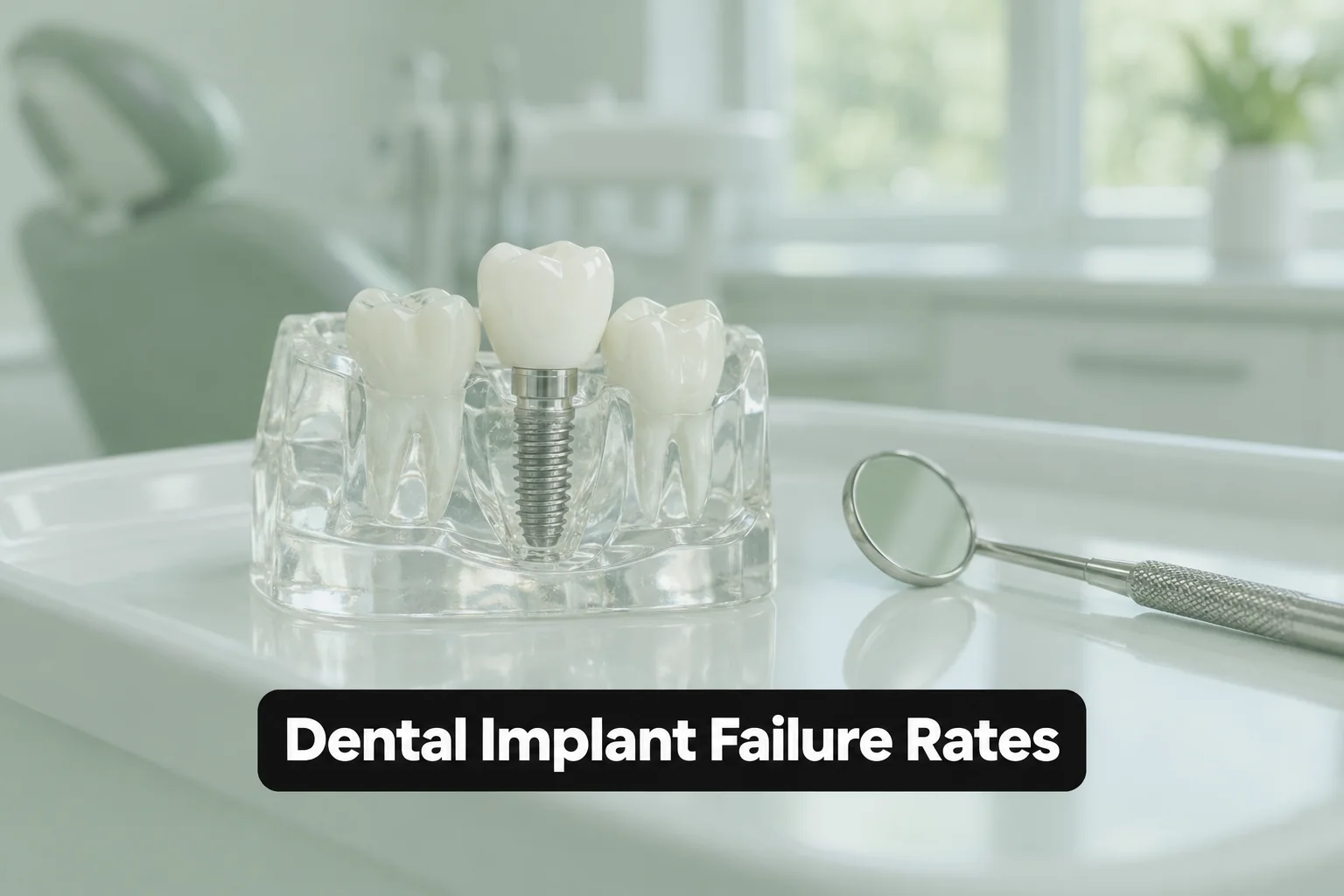
Of 158,824 dental implants placed in 53,874 patients in a large Israeli dental network between 2014 and 2022, 2.21% failed.
Source: Tobias et al., 2025
Dental implants have gone from rare to routine. Among US adults missing at least one tooth, implant use rose from 0.7% at the turn of the century to 5.7% by the middle of the last decade, and the highest projection had it reaching 23% by this year (Elani et al., 2018). With that growth comes the question patients ask most often before they agree to treatment: how often do implants fail?
The short answer is rarely, at least in the first decade. The longer answer depends on what "fail" means. Most published success rates measure survival, which only asks whether the implant is still in the mouth. Far fewer measure whether the gum and bone around it are healthy, and the gap between those two numbers is where most of a patient's real risk sits.
This page brings the figures together from systematic reviews, national registries and cohorts that followed patients for up to twenty-five years. It separates implant-level numbers from patient-level numbers, survival from health, and early failures from late ones, then shows which risk factors move the odds and which do not. Every number links to the study it came from.
Key takeaways
- 96.8%Share of implants still in place after ten years in a 10,871-implant specialist cohort; at the patient level the figure was 92.5%. French et al., 2021
- 19.53%Share of implant patients with peri-implantitis, the bone-destroying gum infection around implants, across 57 studies. Diaz et al., 2022
- 93.0%Pooled 20-year implant survival across ten prospective studies, published in 2026. Lupi et al., 2026
- 78%20-year survival estimate once implants lost to follow-up are imputed, down from 92% when only returning patients are counted. Kupka et al., 2024
- 2.402Odds ratio for implant failure in smokers vs non-smokers across 292 publications. Mustapha et al., 2021
- 18.0%Five-year peri-implantitis incidence in patients who kept up preventive maintenance visits, vs 43.9% in those who did not. Costa et al., 2012
- 88.7%Survival of a replacement implant placed where one implant had already failed. Gomes et al., 2018
How Many Dental Implants Survive Ten, Fifteen and Twenty Years?
Most implants outlast a decade comfortably. A specialist cohort of more than ten thousand implants found 96.8% still in place at ten years and 94.0% at fifteen (French et al., 2021), and a new meta-analysis of prospective studies put twenty-year survival at 93.0% (Lupi et al., 2026). Counted by patient rather than by implant, and with dropouts included, the figures fall.
| Metric | Value | Source |
|---|---|---|
| Implant-level survival at 10 years | 96.8% | |
| Implant-level survival at 15 years | 94.0% | |
| Patients with no implant lost at 10 years | 92.5% | |
| Patients with no implant lost at 15 years | 86% | |
| Mean survival, studies with 10+ years of follow-up | 94.6% | |
| Pooled 20-year survival, prospective studies | 93.0% | |
| 20-year survival, returning patients only | 92% | |
| 20-year survival, lost implants imputed | 78% |
78%
Once implants lost to follow-up are estimated instead of ignored, twenty-year survival drops sharply.
Source: Kupka et al., 2024
Those headline figures are implant-level numbers, and they flatter the experience of an individual patient. In the same cohort, the share of patients who still had every implant they received was 92.5% at ten years and 86% at fifteen (French et al., 2021). A person with four implants has four chances for one of them to fail, so the patient-level figure is the more useful one when weighing the benefits of dental implants against a dental bridge or another replacement.
The second caution is who gets counted. Long studies lose patients: people move, change dentists or stop attending, and an implant that failed after a patient left is never recorded. A twenty-year meta-analysis showed how much this matters. Among patients who returned for examination, survival was 92%; once the authors estimated what happened to the implants that were lost to follow-up, it fell to 78% (Kupka et al., 2024). An earlier systematic review of studies with at least ten years of follow-up reported a mean of 94.6% (Moraschini et al., 2015). The honest reading is that a typical implant is very likely to last decades, and that published survival rates are best treated as the upper end of the range rather than a guarantee.
Still in Your Mouth vs. Still Healthy: Why Survival Is Not Success
Survival only means the implant is present. The International Team for Implantology counts an implant as a success only when it is present and complications are absent (ITI Consensus Conference, 2003). By that stricter test the picture changes: a meta-analysis of fifty-seven studies found peri-implantitis, the infection that destroys bone around an implant, in 19.53% of patients (Diaz et al., 2022).
| Metric | Value | Source |
|---|---|---|
| Definition of implant success (ITI) | complications are absent | |
| 5-year survival, tissue-level implant cohort | 100% | |
| Implants with healthy tissue at 5 years, same cohort | 64% | |
| Patients with peri-implant mucositis | 43% | |
| Patients with peri-implantitis (2015 meta-analysis) | 22% | |
| Patients with peri-implantitis (2022 meta-analysis) | 19.53% | |
| Implants with peri-implantitis (2022 meta-analysis) | 12.53% | |
| Peri-implantitis, single-crown implants, 10 years | 2.3% | |
| Peri-implantitis, single-crown implants, 25 years | 7.8% | |
| Peri-implant mucositis, single-crown implants, 25 years | 74.4% |
64%
In one recent cohort every implant survived five years, yet only about two in three had healthy surrounding tissue.
Source: Sabri et al., 2026
A small cohort published this year makes the gap concrete. Five years after placement, implant survival was 100%, but only 64% of the implants had healthy surrounding tissue; the rest showed mucositis (Sabri et al., 2026). The sample was small, so the exact split should not be generalised, but the pattern matches the larger evidence. A 2015 meta-analysis estimated that 43% of implant patients had peri-implant mucositis and 22% had peri-implantitis (Derks & Tomasi, 2015), and a 2022 update put peri-implantitis at 19.53% of patients and 12.53% of individual implants (Diaz et al., 2022). Mucositis is the implant version of gingivitis: inflamed, bleeding gums with no bone loss yet, and reversible when it is treated. Peri-implantitis is the implant version of the bone loss described in gum disease, and it is the main route to a late failure.
The longest data available show how slowly that risk builds. In a Swiss cohort examined ten and twenty-five years after treatment, peri-implantitis at single-crown implants rose from 2.3% to 7.8%, while mucositis at twenty-five years reached 74.4% (Raabe et al., 2026). Those patients were enrolled in regular supportive care, which likely explains why their peri-implantitis rate sits well below the meta-analysis averages. Inflammation around implants is common; bone-destroying infection is less common, and it tends to be found in the patients who are not being checked.
When Do Implants Fail: During Healing or Years Later?
Failures come in two waves. Early failures happen during healing, when the bone does not fuse to the implant. Late failures come years later, usually from infection or overload. In a registry of 158,824 implants, 2.21% failed overall and 1.56% failed during healing, before the crown was attached (Tobias et al., 2025).
| Metric | Value | Source |
|---|---|---|
| Implants in the registry study | 158,824 | |
| Overall failure rate, registry | 2.21% | |
| Early failure before the crown, registry | 1.56% | |
| Early implant loss, Swedish national sample | 1.4% | |
| Late implant loss by 9 years, Swedish sample | 2.0% | |
| Patients who lost at least one implant, Swedish sample | 7.6% | |
| Failures before loading, specialist cohort | 0.5% | |
| Failures after loading, specialist cohort | 1.2% |
7.6%
Counted by person rather than by implant, roughly one patient in thirteen had lost at least one implant within nine years.
Source: Derks et al., 2015
A randomly selected national sample from Sweden is one of the few sources that avoids the specialist-centre bias. Early implant loss, before the prosthesis was connected, affected 1.4% of implants; late loss among patients examined nine years after treatment affected 2.0% of implants; and 7.6% of patients had lost at least one implant (Derks et al., 2015). That last figure is the one to keep in mind for anyone receiving several implants at once, such as a full mouth reconstruction, because each additional implant adds another chance of a loss even when the per-implant risk is low.
The split between early and late failures depends heavily on how long a study follows its patients. The registry above, with at most about nine years of records, found most failures in the healing phase. A specialist cohort that followed some patients for more than two decades found the reverse: 0.5% of implants failed before loading and 1.2% after (French et al., 2021). Both can be true. The first months carry the highest risk for any single window, but the risk never drops to zero, and the late failures accumulate slowly over the years that registries do not yet cover.
Which Risk Factors Raise the Odds of Implant Failure?
Smoking and a history of gum disease carry the clearest evidence. Across nearly three hundred publications, implants in smokers had an odds ratio of 2.402 for failure (Mustapha et al., 2021), and patients with past periodontitis had a risk ratio of 2.26 for losing an implant after five years (Serroni et al., 2024). Diabetes, often blamed, showed no significant effect.
| Metric | Value | Source |
|---|---|---|
| Raw failure rate, implants in smokers | 6.35% | |
| Raw failure rate, implants in non-smokers | 3.18% | |
| Odds ratio for failure, smokers vs. non-smokers | 2.402 | |
| Risk ratio for failure, diabetic vs. non-diabetic | 1.07 | |
| Risk ratio for implant loss, history of gum disease | 1.69 | |
| Risk ratio for peri-implantitis, history of gum disease | 2.17 | |
| Risk ratio for failure beyond 5 years, past periodontitis | 2.26 | |
| Risk ratio for new peri-implantitis, past periodontitis | 4.09 | |
| Mean survival, mini implants under 3.0 mm | 94.7% | |
| Odds ratio for failure, mini vs. standard implants | 4.54 | |
| Risk ratio for failure, immediate vs. conventional loading | 1.50 | |
| Six-year survival, immediate implants (single 2025 cohort) | 53.2% | |
| Six-year survival, delayed implants (same cohort) | 81.1% |
4.09
In prospective studies, a history of periodontitis was linked to about four times the risk of developing peri-implantitis.
Source: Serroni et al., 2024
Smoking is the most consistently documented risk. Pooled across the studies in one review, the raw failure rate was 6.35% for implants in smokers and 3.18% for implants in non-smokers (Chrcanovic et al., 2015), roughly double, though those raw figures are not adjusted for other differences between the groups. Gum disease is the other strong signal. An earlier meta-analysis found a risk ratio of 1.69 for implant loss and 2.17 for peri-implantitis in patients with periodontal disease (Sgolastra et al., 2015), and a 2024 analysis limited to prospective studies put the risk ratio for new peri-implantitis at 4.09, while rating the certainty of that evidence as low (Serroni et al., 2024). The practical consequence is that active gum disease should be brought under control through periodontal care before an implant goes in, not after.
Diabetes is often listed as a reason implants fail, but a systematic review found a risk ratio of 1.07 for failure in diabetic compared with non-diabetic patients, a difference that was not statistically significant (Chrcanovic et al., 2014). Bone loss around the implants was slightly greater in diabetics, and few studies reported blood sugar control, so the defensible conclusion is that well-managed diabetes is compatible with implants; the link between oral health and overall wellness runs in both directions.
Implant size matters at the extremes, and timing matters less than the loudest claims suggest. Mini implants narrower than three millimetres had a mean survival of 94.7% and an odds ratio of 4.54 for failure compared with standard-diameter implants, while slightly wider narrow implants showed no significant difference (Schiegnitz & Al-Nawas, 2018). For implants loaded immediately, a Cochrane review found no evidence of a difference in first-year failure, with a risk ratio of 1.50 (Esposito et al., 2013). One recent single-centre study circulating online reported six-year survival of 53.2% for immediate implants against 81.1% for delayed ones (Cheng et al., 2025), but those figures sit far below every meta-analysis, including for the delayed group, and should be read as an outlier. Whether an implant can go in on the day of a tooth extraction is a clinical judgment about the bone and the infection at that site, not a question with one answer for everyone.
What Can Patients Control, and What Happens After a Failure?
Maintenance visits are the strongest lever a patient holds. Among people who already had inflamed gums around an implant, 18.0% of those who kept regular maintenance visits developed peri-implantitis within five years, against 43.9% of those who did not (Costa et al., 2012). If an implant does fail, a replacement in the same spot usually survives.
| Metric | Value | Source |
|---|---|---|
| 5-year peri-implantitis incidence, no maintenance | 43.9% | |
| 5-year peri-implantitis incidence, with maintenance | 18.0% | |
| Replacement implant survival after one failure | 88.7% | |
| Replacement implant survival after an early failure | 91.8% | |
| Replacement implant survival after two failures | 67.1% | |
| Weighted survival of implants placed after a failure | 86.3% |
88.7%
A replacement implant placed after one failure survived in nearly nine cases out of ten.
Source: Gomes et al., 2018
The maintenance study was not randomised, and it only followed patients who already had mucositis, so the gap may overstate the effect for a healthy mouth. It is still the clearest number available on a question every implant patient faces, and it lines up with the long-term cohorts in which patients under supportive care had low peri-implantitis rates. In practice, maintenance means a cleaning, exam and x-rays on a regular schedule, with probing around each implant and periodic images to check the bone level. The benefits of regular professional cleanings apply to implants as much as to natural teeth: an implant cannot decay, but the tissue around it can still become infected.
When an implant does fail, the odds for a second attempt are good but lower than for the first. A meta-analysis found that replacement implants placed where one implant had already failed survived at 88.7%, rising to 91.8% when the original failure happened early, and falling to 67.1% after two failures at the same site (Gomes et al., 2018). A separate systematic review put the weighted survival of implants placed after a failure at 86.3% (Oh et al., 2020). The difference usually comes down to whether the cause of the first failure, such as smoking, untreated infection or excessive biting force, was identified and dealt with before the replacement went in.
Frequently Asked Questions
How often do dental implants fail?
Rarely in the first decade. In a registry of 158,824 implants, 2.21% failed, and most of those failed during healing before the crown went on. Counted by patient rather than by implant, a Swedish national sample found 7.6% of patients had lost at least one implant by nine years. (Tobias et al., 2025; Derks et al., 2015)
How long do dental implants last?
Most last decades. A 2026 meta-analysis of ten prospective studies put 20-year survival at 93.0%, and a specialist cohort of 10,871 implants found 94.0% still in place at 15 years. Survival only means the implant is still there; it does not mean the surrounding gum and bone are healthy. (Lupi et al., 2026; French et al., 2021)
What is peri-implantitis, and how common is it?
Peri-implantitis is an infection around an implant that destroys the supporting bone. A 2022 meta-analysis of 57 studies found it in 19.53% of patients and 12.53% of implants. Its milder form, gum inflammation called mucositis, is more common and is reversible when it is treated early. (Diaz et al., 2022)
Does smoking make dental implants fail?
It raises the odds. A meta-analysis of 292 publications found implants in smokers had an odds ratio of 2.402 for failure compared with non-smokers. Smoking reduces blood flow to the healing bone, which matters most in the first months after surgery. Quitting before treatment is the single biggest change a smoker can make. (Mustapha et al., 2021)
Can I get dental implants if I have diabetes?
Often, yes. A systematic review found no significant difference in implant failure between diabetic and non-diabetic patients, with a risk ratio of 1.07. Bone loss around implants was slightly greater in diabetics, and most studies did not report blood sugar control, so well-managed diabetes is the realistic condition for a good result. (Chrcanovic et al., 2014)
Can a failed dental implant be replaced?
Usually. A meta-analysis found replacement implants placed where one implant had already failed survived at 88.7%, rising to 91.8% when the first failure happened early. After two failures at the same site survival fell to 67.1%, so the cause of the first failure needs fixing before a second attempt. (Gomes et al., 2018)
Do I still need dental cleanings after getting an implant?
Yes. In a five-year study of patients who already had gum inflammation around their implants, 18.0% of those who kept regular maintenance visits developed peri-implantitis, compared with 43.9% of those who skipped them. Implants cannot decay, but the gum and bone around them can still become infected. (Costa et al., 2012)
How We Researched This
This analysis draws on peer-reviewed systematic reviews, meta-analyses, national registry studies, long-term cohort studies and the consensus definitions of the International Team for Implantology. Twenty-eight sources were reviewed and twenty-three are cited. Systematic reviews and large or randomly sampled cohorts were preferred over single-practice reports, and figures are labelled as implant-level or patient-level wherever the study made that distinction. Every figure was checked against its source page on the research date; PubMed abstracts, which block automated readers, were confirmed through the National Library of Medicine's E-utilities service, and two PubMed Central pages were re-checked after rate limiting. One widely repeated smoking risk ratio could not be confirmed in an accessible primary source and was excluded in favour of figures that could. Limitations: most survival studies come from specialist centres and lose patients over time, which tends to make survival look better than it is; case definitions for peri-implantitis vary between studies; and risk-factor estimates come from observational studies that cannot adjust for every confounder. Figures from a single small or outlying study are identified as such in the text.
Sources
- Long term clinical performance of 10 871 dental implants with up to 22 years of follow-up: A cohort study in 4247 patients. French et al. Clinical Implant Dentistry and Related Research, 2021.
- Evaluation of survival and success rates of dental implants reported in longitudinal studies with a follow-up period of at least 10 years: a systematic review. Moraschini et al. International Journal of Oral and Maxillofacial Surgery, 2015.
- Peri-implant health and disease. A systematic review of current epidemiology. Derks & Tomasi. Journal of Clinical Periodontology, 2015.
- What is the prevalence of peri-implantitis? A systematic review and meta-analysis. Diaz et al. BMC Oral Health, 2022.
- How far can we go? A 20-year meta-analysis of dental implant survival rates. Kupka et al. Clinical Oral Investigations, 2024.
- Dental Implant Survival Rates: Comprehensive Insights from a Large-Scale Electronic Dental Registry. Tobias et al. Journal of Functional Biomaterials, 2025.
- Smoking and Dental Implants: A Systematic Review and Meta-Analysis. Mustapha et al. Medicina (Kaunas), 2021.
- Smoking and dental implants: A systematic review and meta-analysis. Chrcanovic et al. Journal of Dentistry, 2015.
- Diabetes and oral implant failure: a systematic review. Chrcanovic et al. Journal of Dental Research, 2014.
- Periodontitis, implant loss and peri-implantitis. A meta-analysis. Sgolastra et al. Clinical Oral Implants Research, 2015.
- History of periodontitis as a risk factor for implant failure and incidence of peri-implantitis: A systematic review, meta-analysis, and trial sequential analysis of prospective cohort studies. Serroni et al. Clinical Implant Dentistry and Related Research, 2024.
- Effectiveness of implant therapy analyzed in a Swedish population: early and late implant loss. Derks et al. Journal of Dental Research, 2015.
- Impact of Peri-Implant Phenotype on Implant Therapy Outcomes: A 5-Year Cohort Analysis on Soft Tissue-Level Implants. Sabri et al. Journal of Clinical Periodontology, 2026.
- Crestal Bone Loss and Peri-Implant Conditions at Tissue-Level Implants: Influence of Prosthesis Type After 25 Years. Raabe et al. Clinical Implant Dentistry and Related Research, 2026.
- Dental implant survival and marginal bone loss after a minimum of 20 years: systematic review and meta-analysis of prospective studies. Lupi et al. International Journal of Oral and Maxillofacial Surgery, 2026.
- Influencing factors and survival rates in immediate vs. delayed dental implant placement: a six-year retrospective analysis. Cheng et al. Frontiers in Dental Medicine, 2025.
- Trends in Dental Implant Use in the U.S., 1999-2016, and Projections to 2026. Elani et al. Journal of Dental Research, 2018.
- Narrow-diameter implants: A systematic review and meta-analysis. Schiegnitz & Al-Nawas. Clinical Oral Implants Research, 2018.
- Interventions for replacing missing teeth: different times for loading dental implants. Esposito et al. Cochrane Database of Systematic Reviews, 2013.
- A systematic review and meta-analysis of the survival rate of implants placed in previously failed sites. Gomes et al. Brazilian Oral Research, 2018.
- Survival of dental implants at sites after implant failure: A systematic review. Oh et al. Journal of Prosthetic Dentistry, 2020.
- Peri-implant disease in subjects with and without preventive maintenance: a 5-year follow-up. Costa et al. Journal of Clinical Periodontology, 2012.
- Implant Survival and Complications (consensus statement). ITI Consensus Conference. International Team for Implantology, 2003.